Make every “Made in Canada” claim a fact you can prove.
The problem
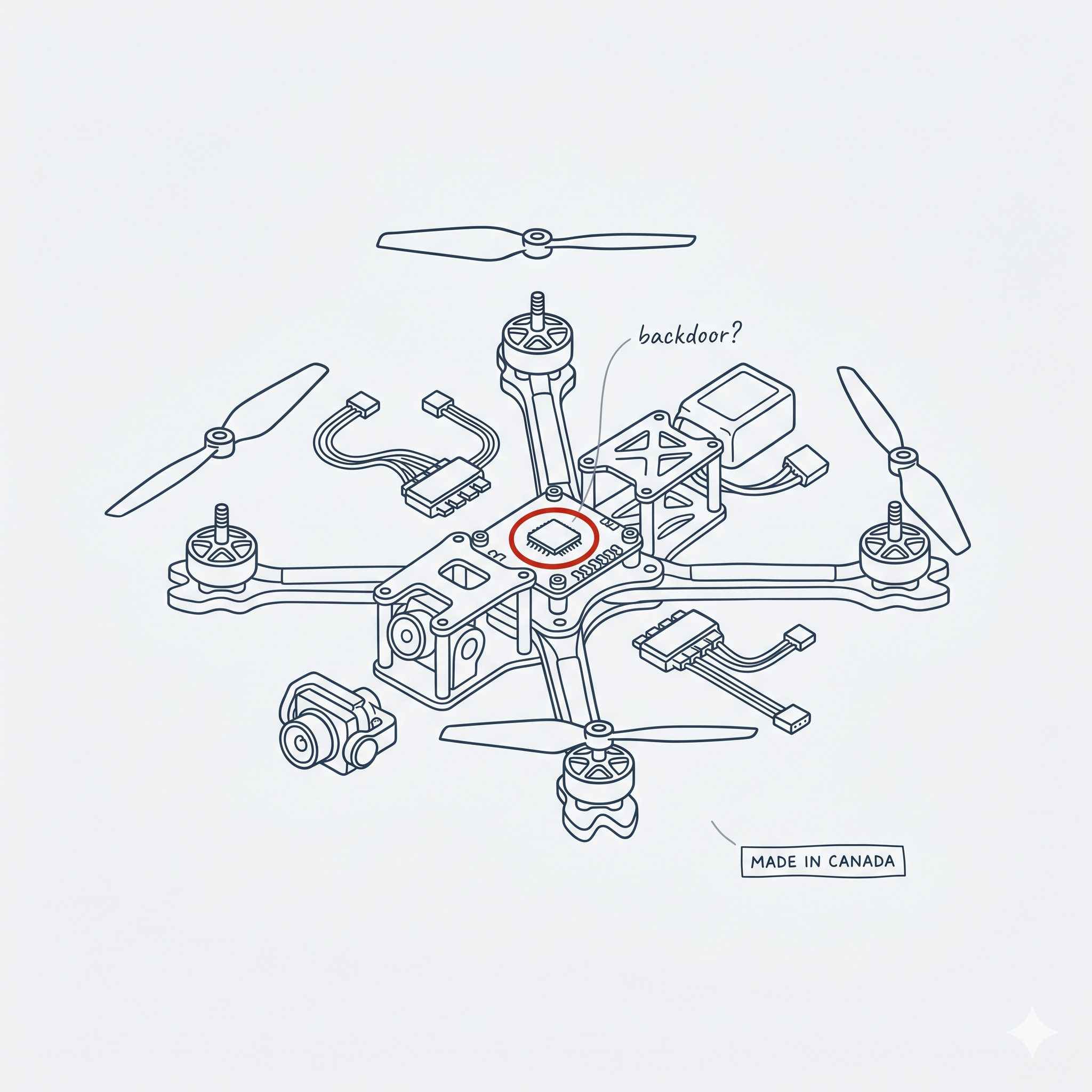
Canada just wrote Buy Canadian into law. But today, no one can prove where a part actually comes from.
The problem
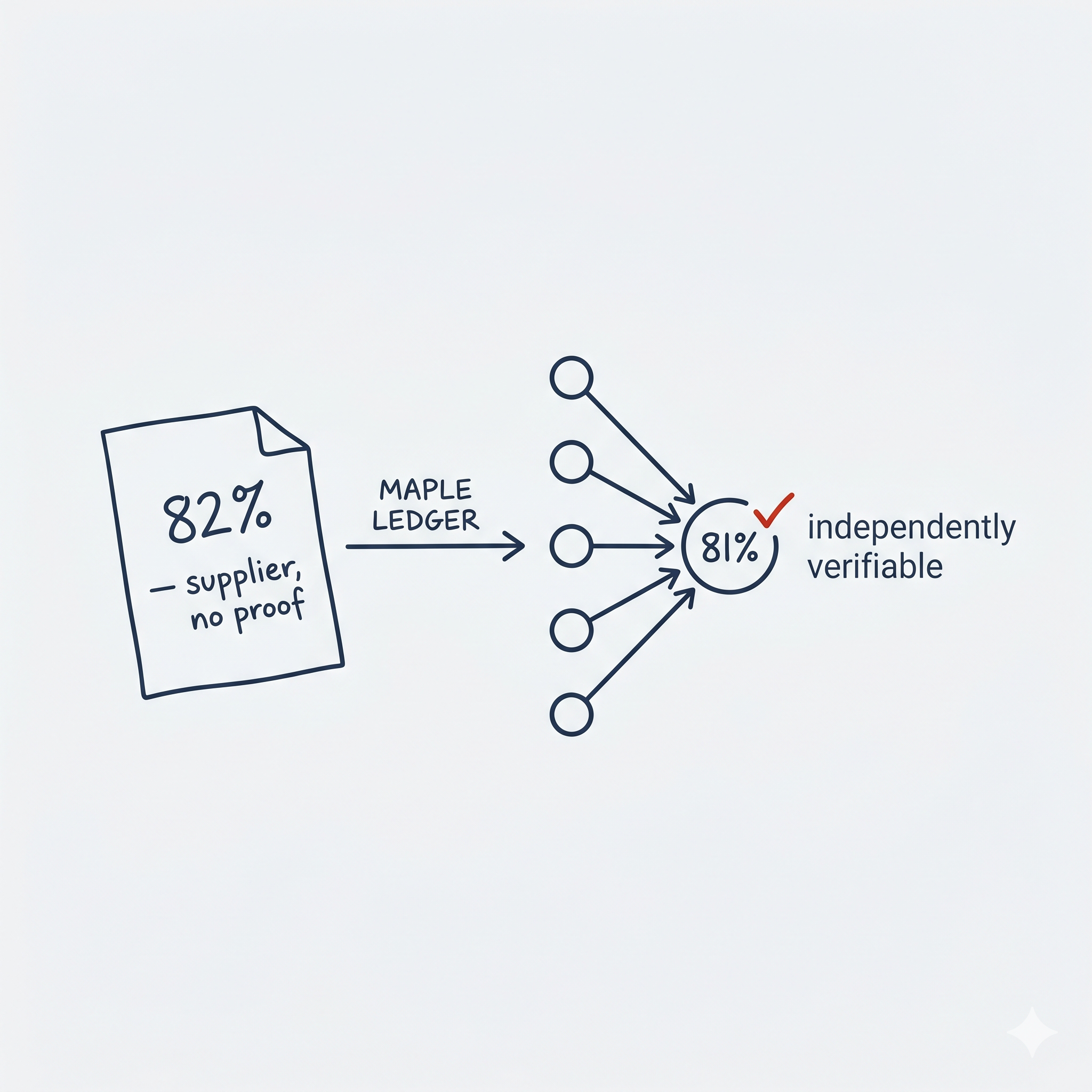
The number the policy relies on is a piece of paper the supplier fills in. That percentage = your bid score = money.
It comes from a self-reported form. Someone has every incentive to inflate it, and nothing can detect it.
The fix
Turn that number into something provable.
Build chainCompute %Catch fraud
The method
From a pile of parts to one provable number.
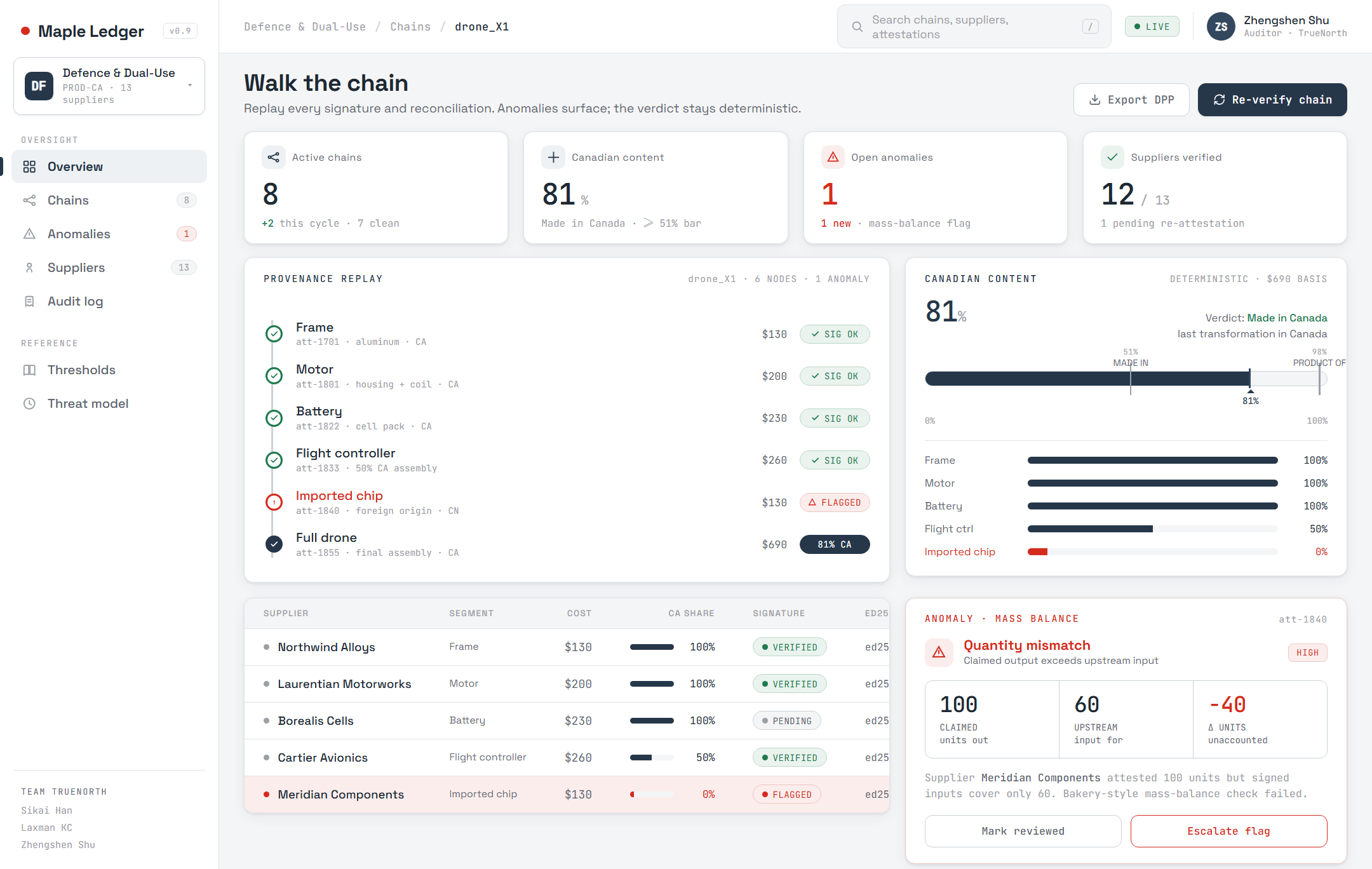
Each node carries its own cost and the Canadian share of it; summed leaf-to-root, the whole drone’s percentage falls out. Tamper with one node and the chain breaks.
The proof
One drone, one hard verdict.
The system sums Canadian content along the chain to 81%, then applies the legal test.
81%this drone
Below bar
Made in Canada ✓
0
51
Made in Canada threshold
98
Product of Canada threshold
✓
Made in Canada
81% ≥ 51% · final assembly in Canada
✗
Product of Canada
81% < 98% · held down by one imported chip
Thresholds 51 / 98: Canada Competition Bureau guidelines · parts & figures illustrative.
Threat model
The fraud that hides in real signatures.
The hardest fraud is when every signature is genuine, but the quantities lie. A mass-balance check catches it.
100
loaves a bakery claims
where did the other 40 come from? ✗ flagged
60
loaves its flour can make
Of four kinds of origin fraud, we cover three, fully or in part. The fourth needs a physical tag, and we say so: in defence, credibility is knowing your limits.
Architecture
Maple Ledger is a 6-layer system; you just saw the core 3.
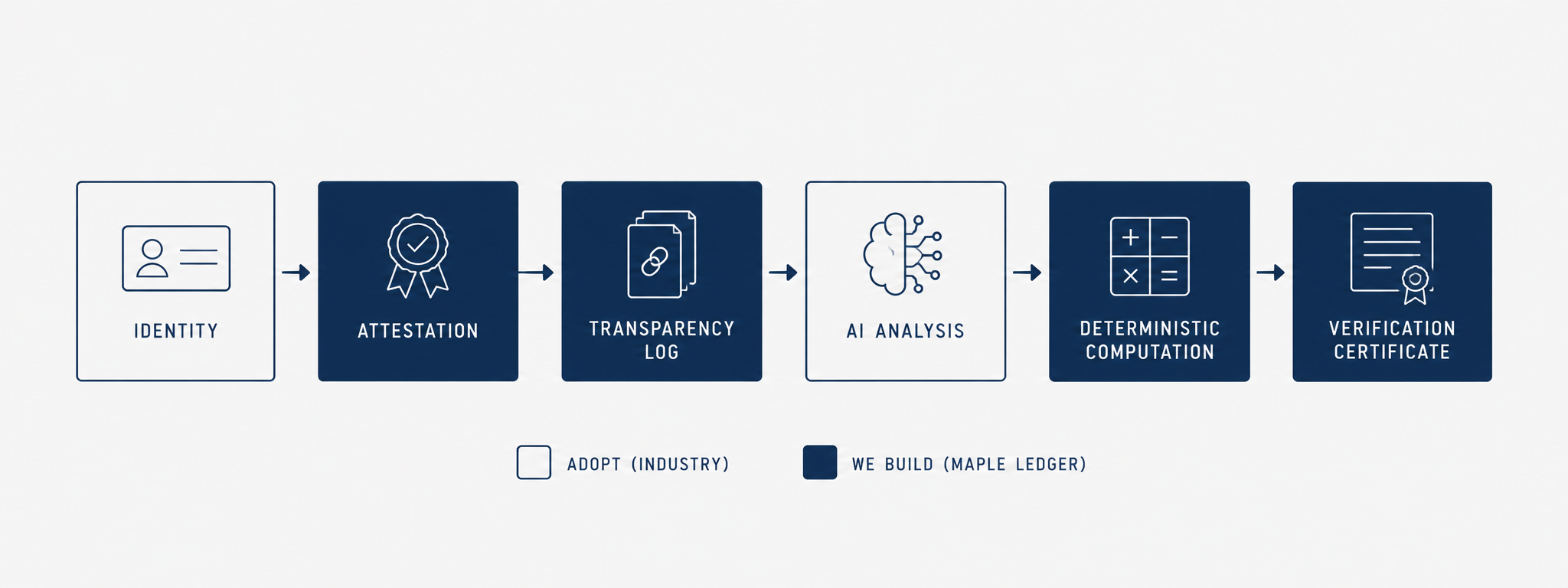
Demo covers L2 · L3 · L5 · L6, a thin but complete slice; L1 identity + L4 AI come in production. Prototype 6 wks · Production 12 wks · < $50k (estimate)
Architecture
Built and running. Backend + detection pipeline.
Architecture · deployment
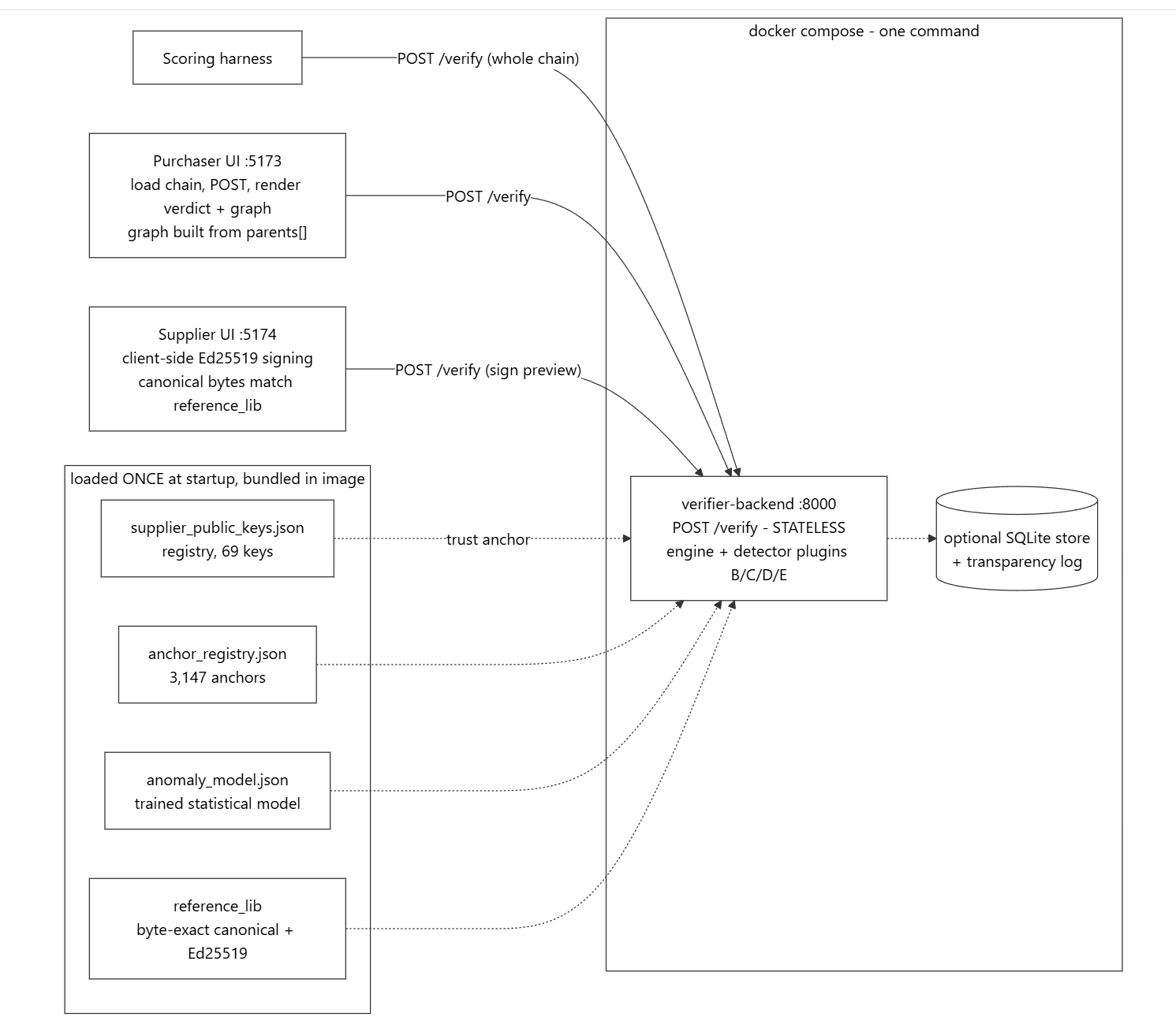
Detection pipeline · POST /verify
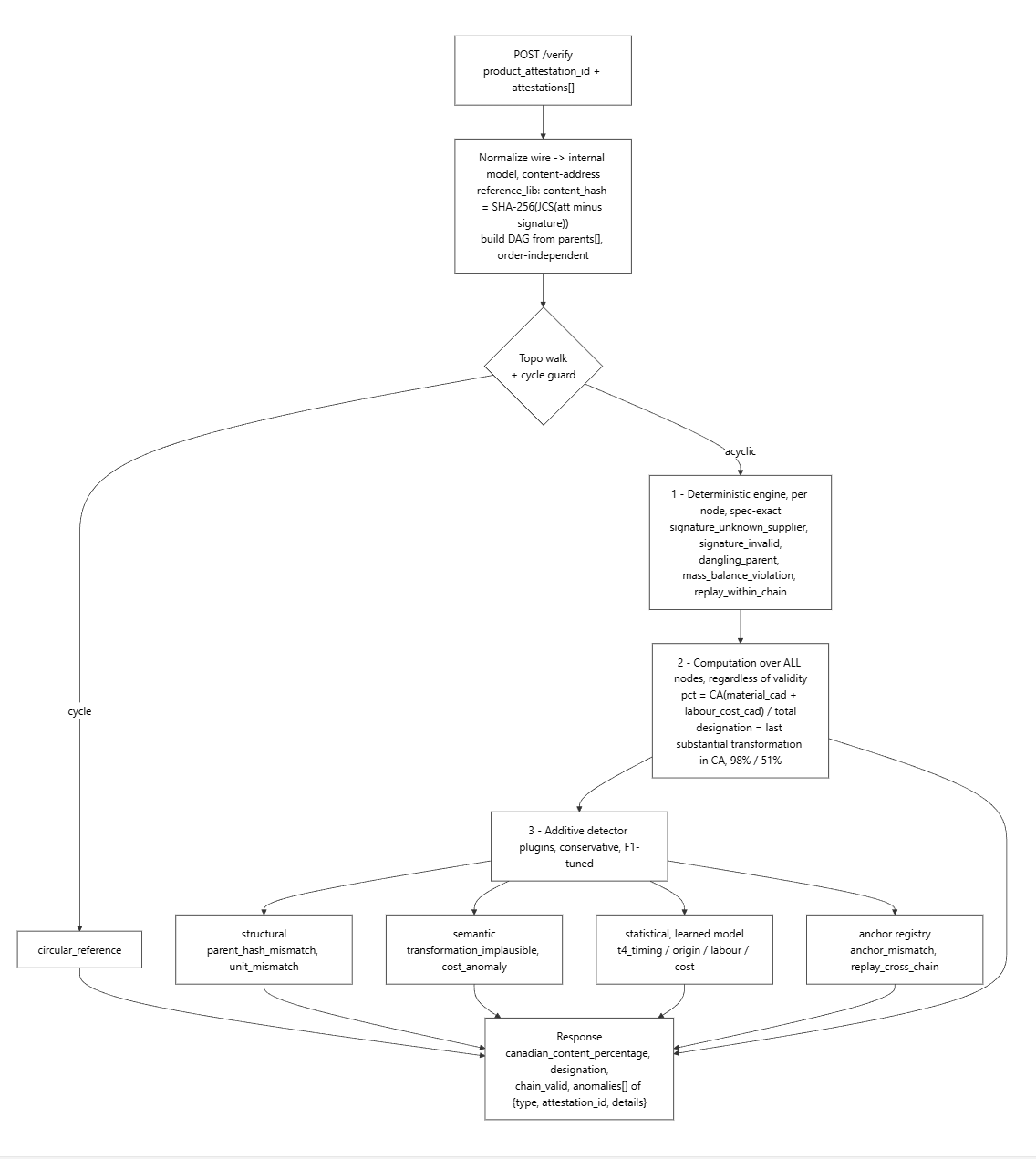
Architecture
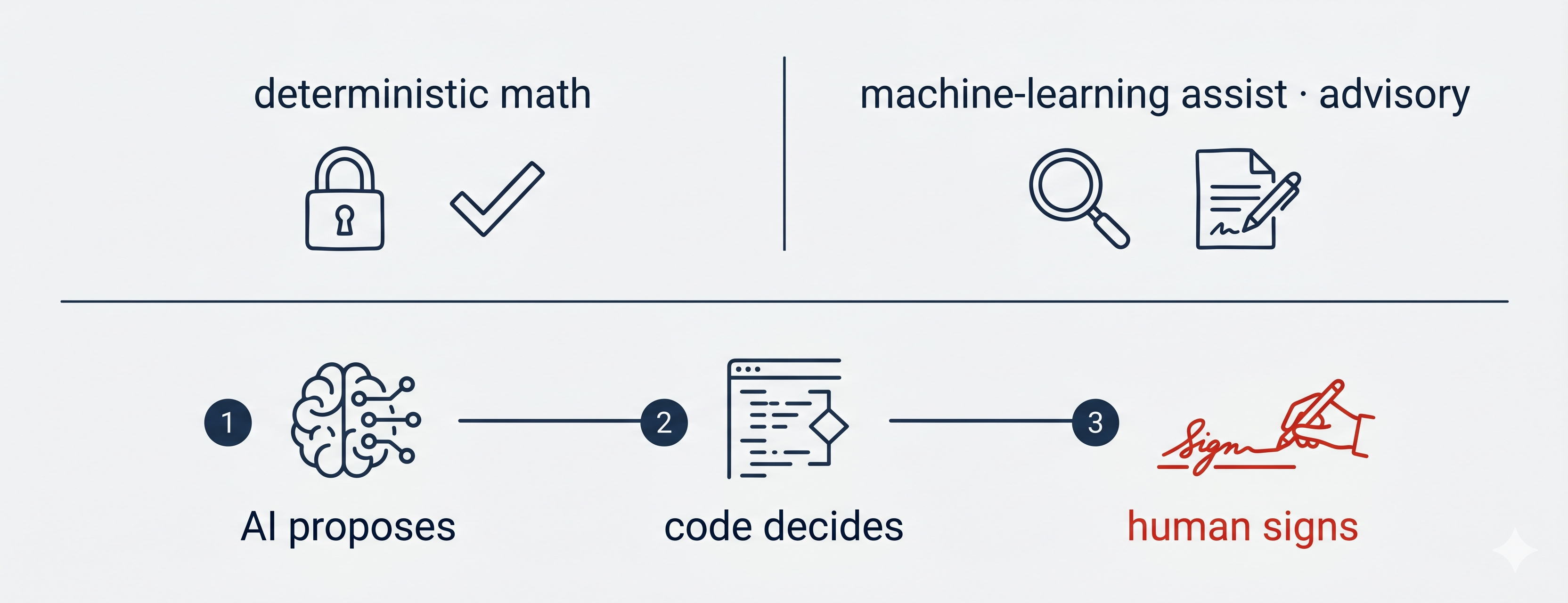
Crypto for integrity, AI for plausibility.
The product
Supplier issues a signed attestation.
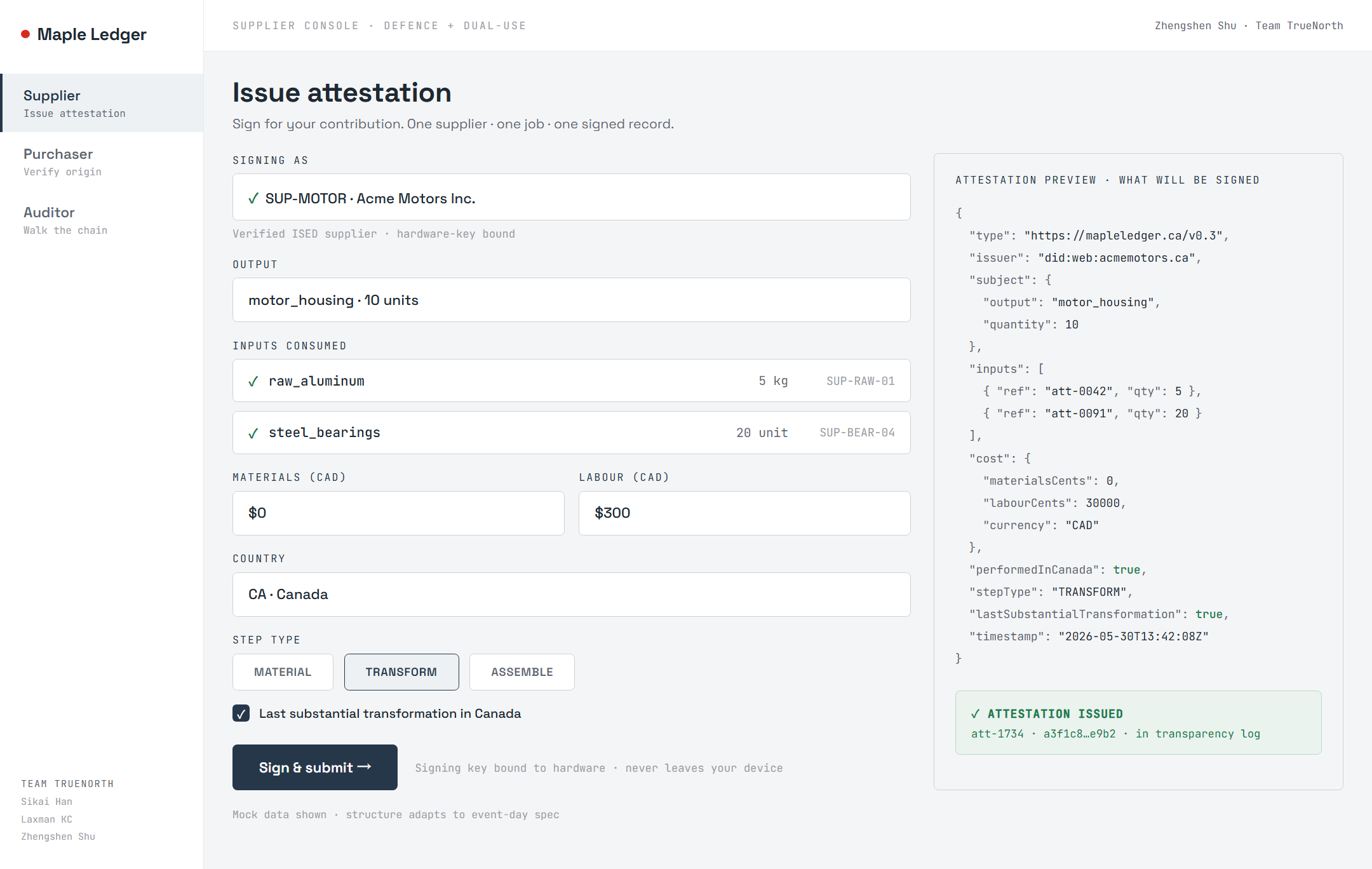
Materials, labour, and location, signed with a verified key. One supplier, one job, one record.
The product
Purchaser scans, gets a hard verdict.
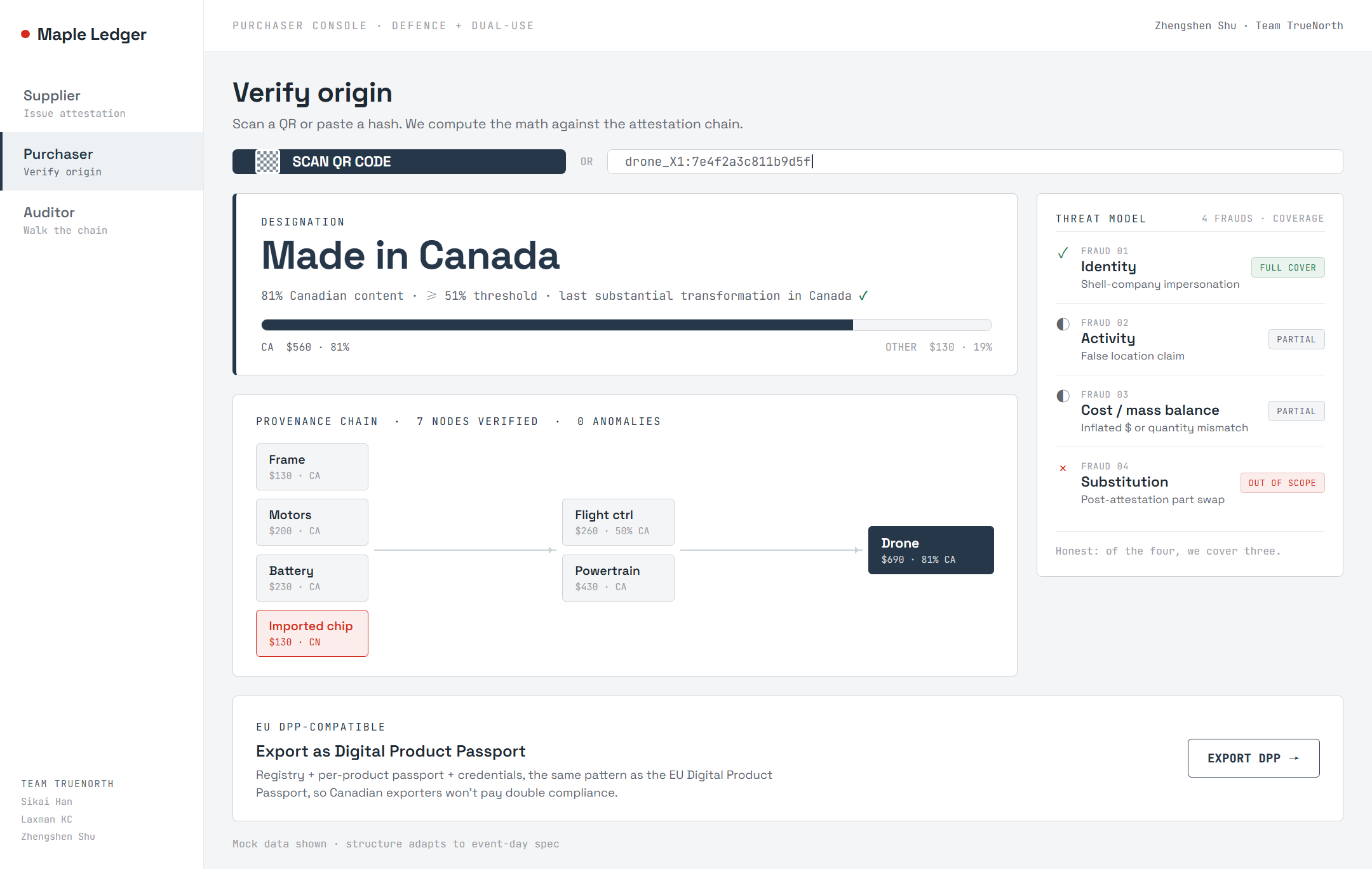
Scan a product: provenance, Canadian-content percentage, and the legal designation in seconds. No engineer needed.
The product
Issue, then verify. Two roles, one chain.
Supplier · issue
Purchaser · verify
The product
Walk the chain, spot the anomaly.
Auditor · oversight
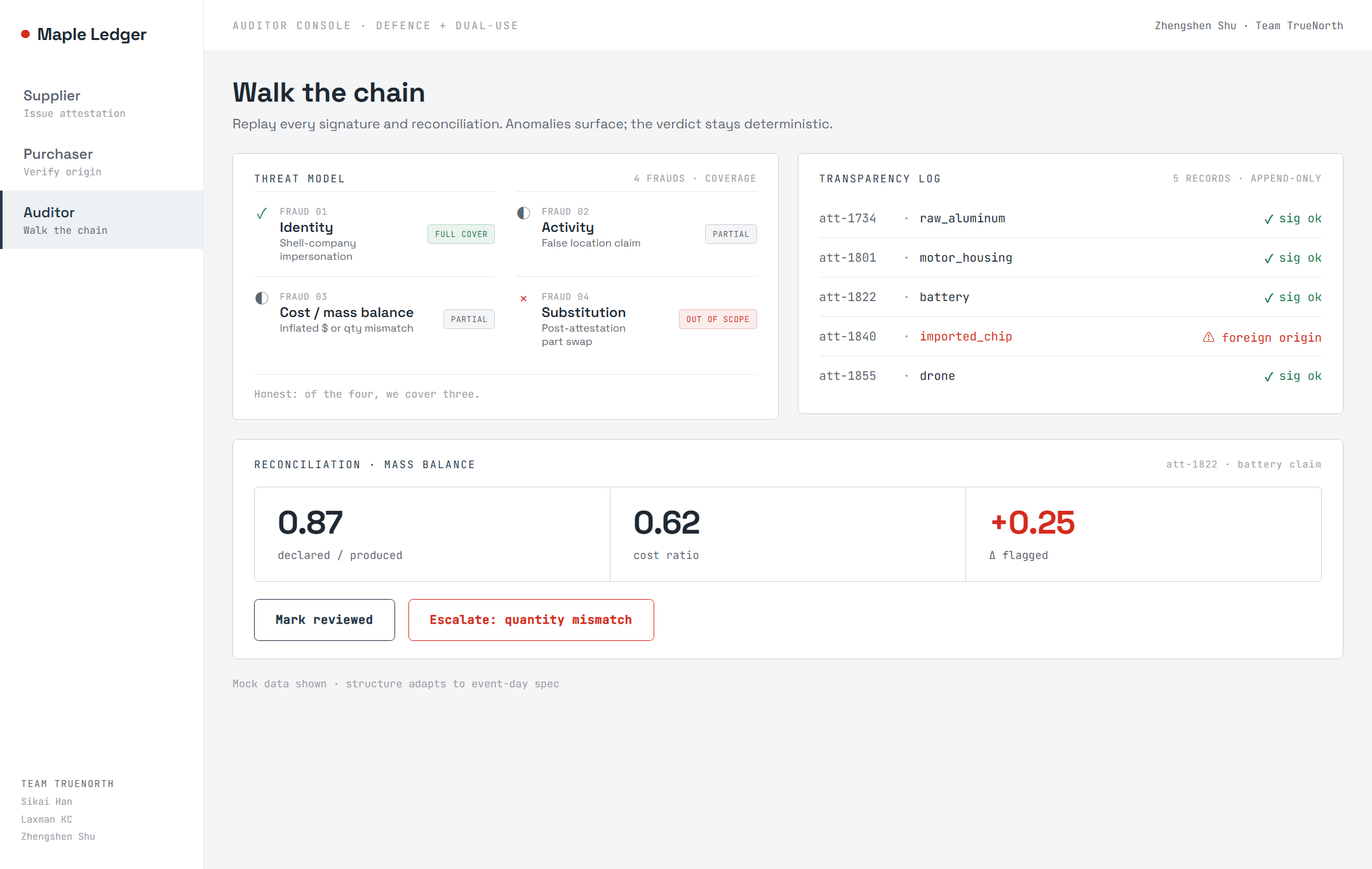
Auditor · full dashboard
Roadmap
Who sees what. Need-to-know, enforced.
Public
Border CBSA
Prime contractor
Admin
Designation (Made in Canada)
✓
✓
✓
✓
Canadian-content %
✓
✓
✓
✓
Provenance chain
✓
✓
✓
Supplier cost breakdown
✓
Supplier identity
✓
✓
✓
✓ visible · = need-to-know (hidden) · the chain stays verifiable for everyone, the detail is gated by role · planned
Roadmap
Same number, different weight.
StructuralPropulsionSensingComputePower
81%
Drone A
imported: Compute (flight-control chip)
same %, different risk
81%
Drone B
imported: Structural (a bracket)
We label the category, never rank importance: that is a policy call, and it differs by buyer. The AI classifies; you weigh. (Planned.)
Why now
Why now, and why it actually ships.
Buy Canadian became law on 2025/12/16; the threshold drops to $5M on 2026/6/15. The standards we build on are already mature. The window is open now.
No lock-inEvery flexible choice lives behind one function in one file. If ISED says “swap the anomaly detector,” we ship a new function, not a new system. That’s how you pass a real RFP.
Maple LedgerTeam TrueNorth · Ottawa
Proof.
Not promises.
From “trust me” to “check me.”
An invoice you have to believe, into a certificate you can check. Not just drones.